Crown Heights archivist hauls a lost trove of subway papers home from Virginia
About 30 boxes collected by subway historian Hugh A. Dunne sat in a Virginia warehouse until a Brooklyn rare books dealer rented a U-Haul.
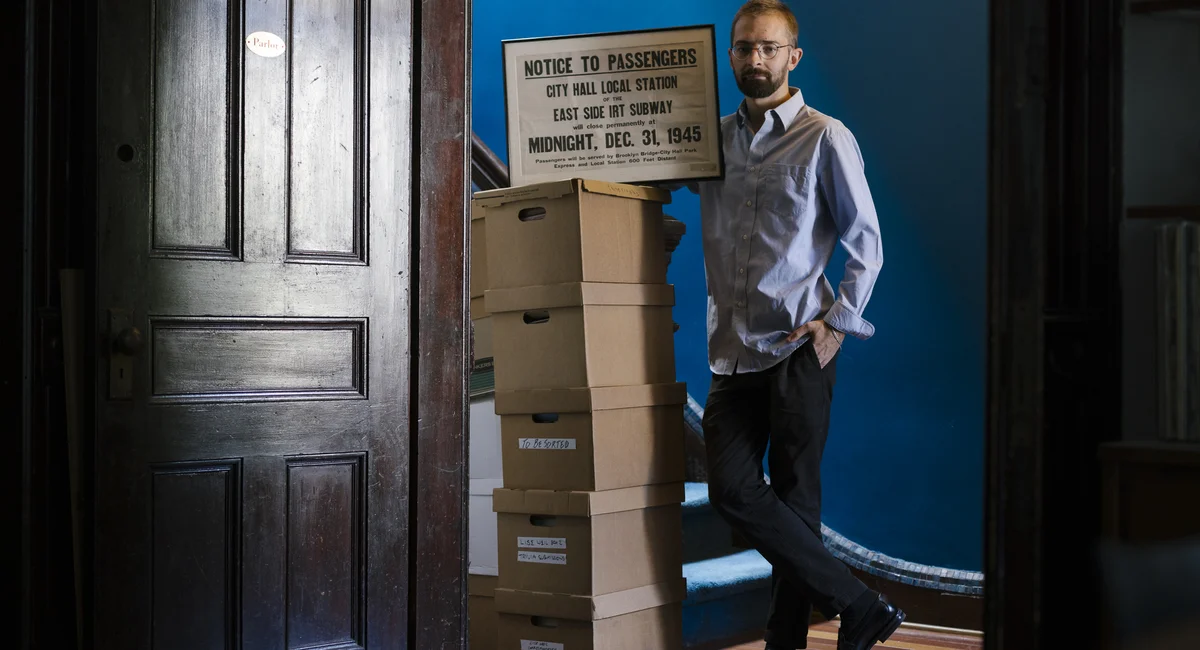
A Crown Heights archivist is sorting through roughly 30 boxes of New York City transit records that turned up this summer in a Virginia warehouse. The boxes hold the lifelong collection of subway historian Hugh A. Dunne.
Daylon Orr, 31, spotted the stack while visiting a friend who sells books in Virginia. The boxes sat in a back corner and were labeled IRT, short for the Interborough Rapid Transit Company, a private operator whose lines later became part of the city subway. Orr bought the lot, rented a U-Haul and drove it back to Brooklyn. The friend who had come down with him had to make the trip home alone.
“I felt like I could steward it to a good home and give it the light that it deserves,” Orr said.
Who was Hugh Dunne, “Mr. Subways”
Dunne collected subway material for most of his life and worked briefly for the MTA. His deep knowledge of the system earned him the nickname “Mr. Subways,” and he turned up at nearly every subway crisis of his era. He also walked more than half of the network’s 600 miles of track. Dunne died in 2005. His estate appears to have sold the collection to one bookseller, who later sold it to the Virginia dealer, and Orr bought it from him.
About five of the boxes hold Dunne’s own letters and memos written against him. One questions his drinking and blames him for the return of the Franklin Avenue Shuttle, a reopening he had pushed for.
What is in the subway archive
The papers appear to cover nearly every company and agency connected to city transit, from the earliest years to the early 2000s. Orr has found training manuals and codes of conduct, official maps next to maps drawn by fans, handwritten timetables and unpublished drafts. There are also internal memos passed between transit officials, designers, historians and other collectors. One box holds staff newsletters from the early 1900s. Others hold typed records that follow individual subway cars from service to the repair shop to retirement. There are files on the Public Service Commission, an early regulator, a report dated 1911 and a separate paper from the Interborough Metropolitan Street Railway Company. Some internal papers from the 1970s and 1980s carry bold, pop art-style graphics.
Cataloging it all is slow going, and Orr called the job “an ongoing organizational nightmare.” The work happens at Fugitive Materials, the Crown Heights archive, rare books broker and publisher he has run for six years. He came to it with ten years of experience selling rare books and built the business around underground and oppositional material that he felt the mainstream trade overlooked.
Quick answers
Who was Hugh Dunne?
A subway historian and collector who worked briefly for the MTA, was nicknamed “Mr. Subways” and walked more than half of the system’s track. He died in 2005.
What is in the subway archive?
Training manuals, codes of conduct, official and fan-made maps, handwritten timetables, internal memos, early 1900s staff newsletters and typed records on individual subway cars.
Where is the collection now?
In Crown Heights, Brooklyn, where archivist Daylon Orr of Fugitive Materials is cataloging it.